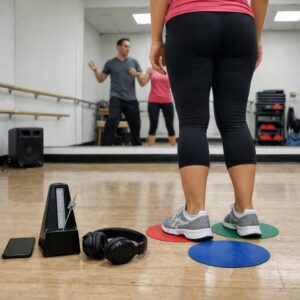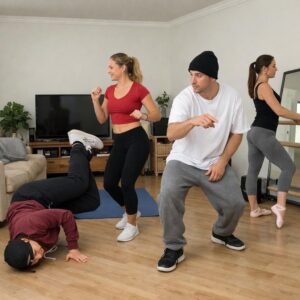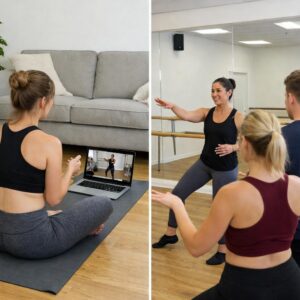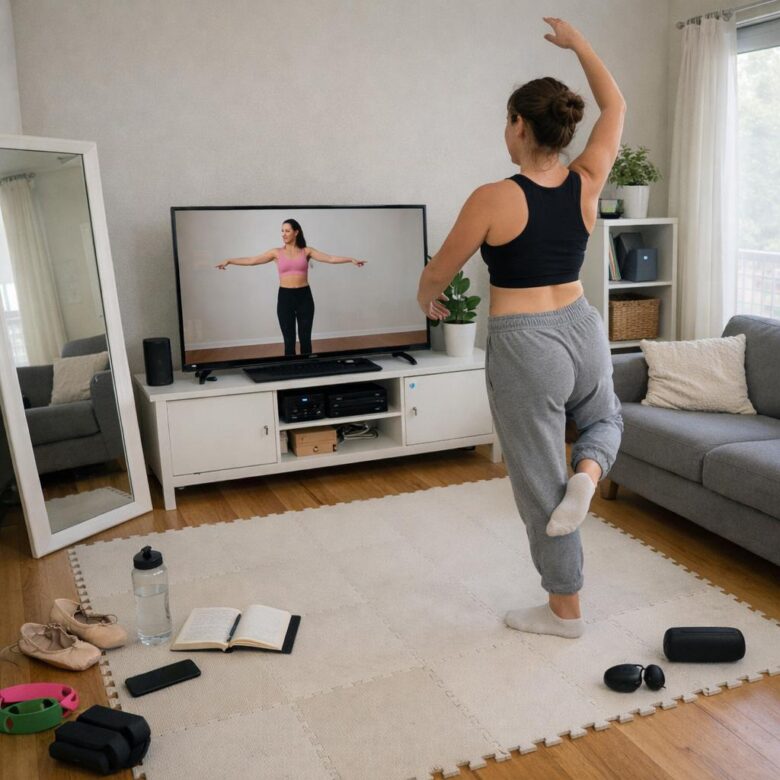
For your next home dance session, choose one short section of choreography and one thing to work on: remembering the steps, staying on the beat, or moving into the next phrase without stopping. Leave the rest for another session.
Use the plan below as a practice experiment, not a promise of faster progress or a daily training requirement.
Check your practice space first
Clear debris and check for slick spots before dancing. Boston Children’s Hospital includes these floor checks in its dance injury-prevention guidance. Source: Boston Children’s Hospital.
Walk through the space your chosen steps will use, including arm reaches. If the phrase takes you toward furniture, shorten the travel or choose a stationary section instead. Keep your screen and recording device outside that space.
Wear properly fitted footwear appropriate for your practice; poorly fitted shoes are among the factors associated with dance ankle sprains. Source: Johns Hopkins Medicine. Ask your instructor about footwear for your dance style and home surface rather than buying a generic pair of “dance shoes.”
Warm up before working on choreography
Warm up before dance practice, rather than starting with your hardest sequence. Johns Hopkins Medicine recommends warming up before training or performing. Source: Johns Hopkins Medicine.
Follow a beginner warm-up suited to the style you are learning. Do not treat a fixed five-minute timer as proof that you are ready for every movement. If time is limited, shorten the choreography portion rather than leave out the warm-up.
Try a 15-minute skill block after warming up
These timings are an organizational suggestion, not a tested formula for improvement. Adjust them to your experience and the material.
- Two minutes: choose and watch. Pick a short phrase from a beginner lesson. Note the starting foot, direction of travel, and ending position. Check whether the instructor says the demonstration is mirrored.
- Four minutes: practice the feet. Work slowly without music at first. Say the step names or counts aloud. Pause at the end and check which foot is free for the next step.
- Four minutes: connect the phrase. Add the arms, then try the sequence with music at a manageable tempo. If one transition keeps interrupting you, practice the step before it and the step after it together.
- Three minutes: record and adjust. Film one short attempt, review one detail, and try again with that detail in mind.
- Two minutes: make a note. Write down what you practiced and where to start next time.
Give each drill a clear question
Instead of deciding whether a run-through looks “good,” choose a question you can answer:
- Timing: Can I clap the rhythm, then step to it without adding arms?
- Footwork: Do I start and finish on the intended foot?
- Transitions: Can I connect the last two counts of one phrase to the first two counts of the next?
- Recall: Can I try the section without watching the screen?
For example, if you hesitate when changing direction, isolate that change instead of restarting the whole song. Try it slowly, then return it to the surrounding phrase.
Review one thing on video
Position your phone so your entire body, including your feet, stays in frame. Use the same angle when comparing attempts.
Watch once for your chosen goal. For a timing check, listen for where your steps land in the music. For footwork, check the starting foot and each weight change. Avoid trying to correct your arms, expression, posture, and timing all at once.
Keep your notes specific: “I paused before the direction change” gives you a clearer next task than “I looked awkward.” If you cannot work out the correction, bring that short clip and question to an instructor.
Plan the next session without forcing daily practice
Choose practice slots that fit your week, but leave room for recovery. Adequate rest and avoiding overtraining are part of Johns Hopkins Medicine’s dance injury-prevention advice. Source: Johns Hopkins Medicine.
Do not keep repeating a move through pain. Pain that worsens with activity, changes how you move, or wakes you at night warrants assessment by a medical professional. Source: Johns Hopkins Medicine.
End each session with one next step, such as “repeat the direction change slowly” or “try the phrase without the screen.” Use that note—not a new routine—as your starting point next time.

GenDance Wellness is maintained by the GenDance Editorial Team and publishes informational content about dance fitness, beginner learning, dance gear, and safer home practice.