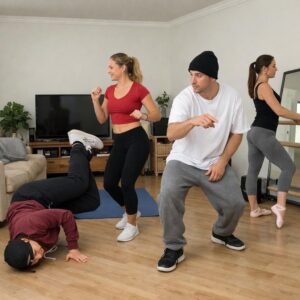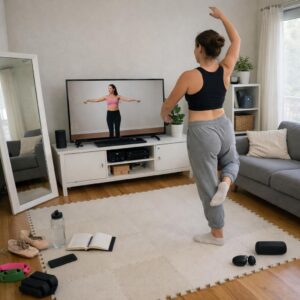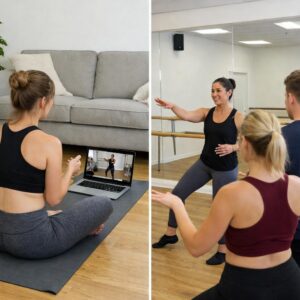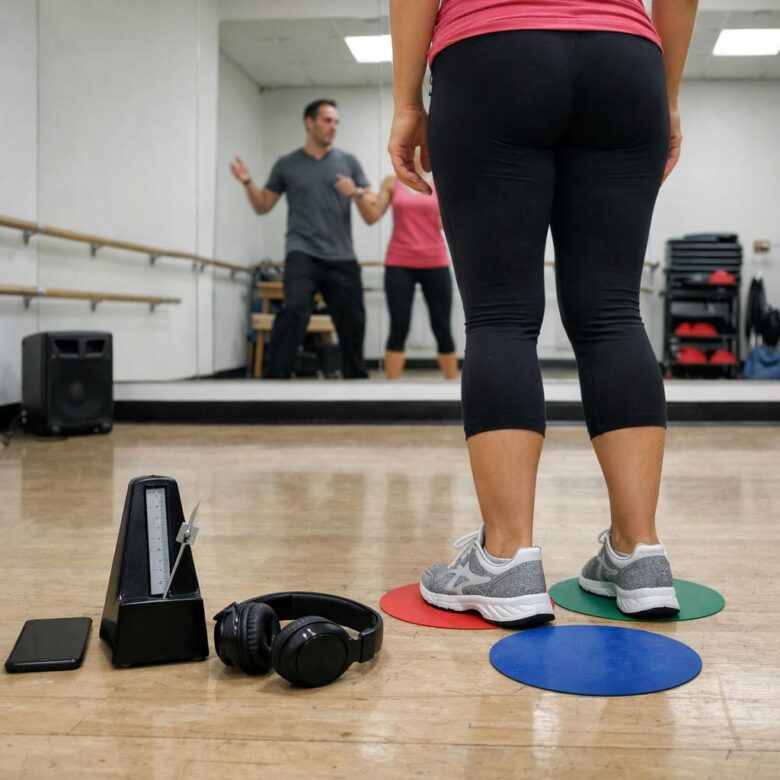
If you lose the beat when you add your arms—or know the steps but rush the transitions—practice those pieces separately. Start with a steady pulse, add simple footwork, then work on one extra movement at a time.
Find the beat before adding steps
Choose a song with a clear, steady pulse. For this exercise, avoid tracks with frequent tempo changes or long sections without an obvious beat.
- Listen first. Leave your feet still and tap along to the pulse you hear.
- Clap the same pulse. Try to keep each clap evenly spaced rather than following every word or drum sound.
- Add a count. Use a track your instructor counts in eight and say “1, 2, 3, 4, 5, 6, 7, 8.” Repeat without pausing after eight.
- Try stepping. March gently in place, placing one foot down on each count.
If you cannot find a consistent pulse, ask a teacher to clap along with that specific track. Do not force an eight-count onto every piece of music; use the count taught for your dance style and song.
Use a metronome to simplify timing practice
Try a metronome when the music feels distracting. Choose a comfortable pace rather than a target speed.
- Clap once per click for 16 clicks.
- March once per click for another 16.
- Alternate four clicks of clapping with four clicks of marching, keeping the count continuous.
Listen for whether your clap and the click sound together or as two separate sounds. If you repeatedly arrive late, make the movement smaller or lower the tempo. Return to the song afterward and try the same task.
Separate stepping from tapping
For this drill, treat a step as a change of supporting foot and a tap as a touch without switching support.
- Step a small distance to the right on count 1.
- Tap your left foot beside your right on count 2, leaving your weight on the right.
- Step left on count 3.
- Tap your right foot beside your left on count 4.
Repeat while saying “step, tap, step, tap.” Notice whether the tapping foot is free to move again. Keep this as a separate coordination exercise rather than substituting it for a style-specific basic step.
Add one movement layer at a time
Use the same step-touch pattern for each round:
- Feet only: Leave your arms relaxed and focus on the counts.
- Arms only: Stop stepping and practice a small forward reach on counts 1 and 3, returning your hands on 2 and 4.
- Combine: Add the reach to your side steps.
If your feet stop or the count disappears, return to feet only. Before adding turns from a routine, practice its approach steps and exit steps separately, using the technique taught in class.
Check one timing issue at a time
Record a short practice clip with the music audible. Review a single question: Do your feet contact the floor on the intended count? Avoid judging your whole performance at once.
- Starting late: Count one full phrase before beginning.
- Rushing a pause: Say every count aloud, including counts with no step.
- Losing timing when arms enter: Simplify the arm movement and repeat the footwork.
- Stumbling at a transition: Loop the last two counts of one section and the first two of the next.
Move from counting to musical choices
Once the basic exercise feels manageable, repeat it with three different intentions: keep every step even, emphasize one clear accent, then hold still through a chosen pause. Treat this as an exploration, not a test of which version looks best.
Keep practice focused and comfortable
Warm up with light movement before dancing, and do not continue dancing through pain. Boston Children’s Hospital’s dance injury-prevention guidance.
For a short practice session, choose one listening drill, one footwork drill, and one combination. Finish by repeating the original task and noting something specific: whether you kept the count, distinguished steps from taps, or added your arms without stopping. Use that observation—not a deadline—to choose what to practice next.

GenDance Wellness is maintained by the GenDance Editorial Team and publishes informational content about dance fitness, beginner learning, dance gear, and safer home practice.