Start with two questions: When can you realistically attend, and do you need someone to watch you dance? Use those answers to narrow your choices, then compare the actual classes—not just the online and in-person labels.
For practice on your own schedule, look for recorded lessons. For individual corrections, look for a class that explicitly includes feedback. For partner dancing, prioritize opportunities to practice with a partner. You can also combine formats without committing to two memberships.
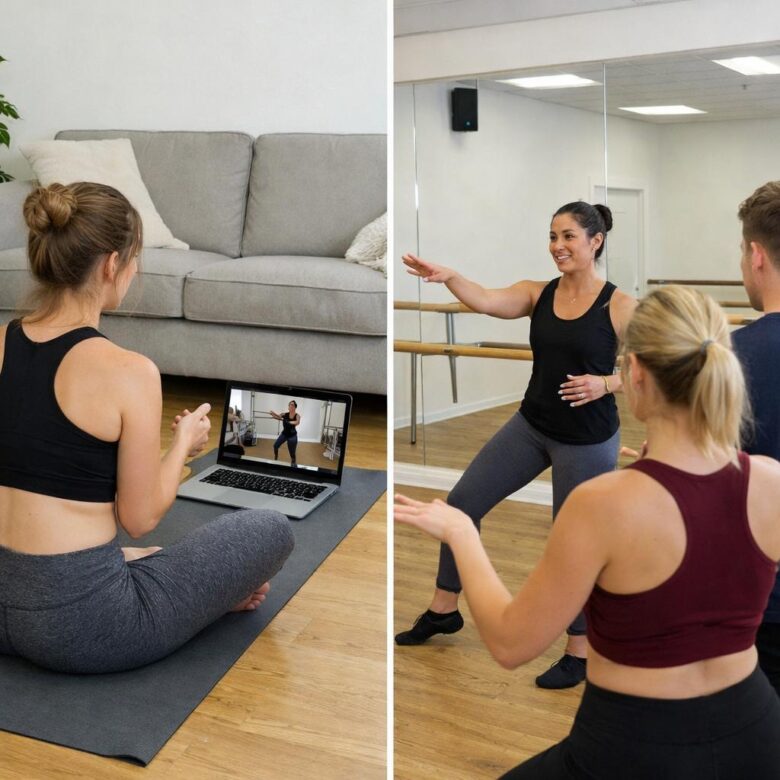
Compare three formats, not two
Before enrolling, separate recorded instruction from live online coaching. For example, the Royal Academy of Dance offers at-home video exercises and classes; that is different from booking a teacher to observe your practice. Explore the RAD’s at-home resources.
| Format | Consider it when you want… | Check before paying |
|---|---|---|
| Recorded online lessons | Practice without a fixed appointment and revisit sections as needed. | Can you pause and replay lessons? How long does access last? Is there a separate way to ask questions or submit a video? |
| Live online lessons | Attend a scheduled class without traveling to a studio. | Will the instructor watch participants? Are corrections included? Can you fit your whole body in the camera view? |
| In-person lessons | Learn in a shared practice setting, work with a partner, or receive instruction away from home. | What is the class size? Is individual feedback part of the lesson? Do you need to bring a partner? |
Do not treat “live” as a promise of personal coaching. Ask how feedback works in the particular class, whether it meets online or in a studio.
Match the class to a specific goal
Learning choreography at your own pace
Look for a recorded beginner series with a clear sequence, explanations of unfamiliar steps, and a preview lesson. Try the preview before subscribing: can you follow the instruction without repeatedly guessing which foot moves next?
Working on technique
Prioritize observation and specific corrections over the delivery format. Ask whether the teacher works with adult beginners in your chosen style and how they adapt lessons to your starting point. The Royal Academy of Dance’s professional code calls for registered teachers to plan around students’ abilities and prior experience. Read the RAD teaching standards.
A useful question is: “If I cannot understand or perform a step, how will you help me work on it?”
Preparing for a wedding dance or social dancing
Look for instruction that includes practice with your intended partner rather than only solo footwork. Tell the teacher your deadline, experience, music choice, and available practice space. For a group class, ask about partner rotation and whether attending alone is welcome.
Making dance part of your weekly routine
Choose a trial based on the obstacle you actually face. If travel makes attendance difficult, test an at-home option. If you keep postponing solo practice, try a scheduled class. If meeting people is part of the goal, ask about beginner socials or opportunities to interact before and after class.
Compare the full cost
Do not assume an online subscription is the least expensive choice or that a private lesson is necessary. Review the terms for the options you are considering and compare:
- Instruction: Drop-in rates, class packages, subscriptions, and any separate feedback fees.
- Attendance: Travel time, parking, childcare, and cancellation or missed-class policies.
- Access: Package expiration dates, recording availability, automatic renewal, and cancellation deadlines.
- Setup: Any required clothing, footwear, equipment, or changes to your practice space.
For a practical comparison, divide your expected monthly spending by the number of sessions you realistically plan to complete. Treat that as a budgeting estimate—not a measure of teaching quality.
Check your home setup before subscribing
Ask the provider how much room the class needs, whether it includes traveling steps or jumps, and what footwear is appropriate for the style and your floor. Do this before buying a mirror, mat, or shoes.
Flooring deserves particular attention. Hospital for Special Surgery advises avoiding uneven dance surfaces and recommends a sprung floor for dance styles involving jumps because it absorbs shock. Read HSS guidance on dance surfaces and ankle injury prevention.
If your home setup does not meet the class requirements, ask for a suitable alternative rather than assuming you can perform the entire studio routine there.
For live coaching, test the camera position before class. Ask the instructor to confirm that they can see the movements they need to assess. Also check whether sessions are recorded, who can access the recordings, and whether you can participate without being recorded.
Use a trial to judge the teaching
Before buying a long package, try a single class or short introductory option when available. Afterward, answer these questions:
- Was the stated level a reasonable match for my experience?
- Could I follow the explanations and demonstrations?
- Did I receive the feedback I was promised?
- Did the pace leave room to understand the material?
- Could I fit this class into an ordinary week?
- Do I know what to practice next?
If you want to combine formats, start simply: ask a teacher for a small set of practice tasks, work on them between lessons, and arrange another check-in when you need feedback. There is no need to assume that adding more subscriptions or classes will produce faster progress.
Which should you choose?
Try recorded online lessons when flexible timing and repeatable instruction are your main priorities. Try live coaching when you want observation and corrections but prefer to stay home. Try in-person lessons when partner practice, a shared setting, or access to an appropriate dance space matters most.
Choose a manageable first commitment, then reassess based on attendance, clarity of instruction, and whether the class addresses your goal.

GenDance Wellness is maintained by the GenDance Editorial Team and publishes informational content about dance fitness, beginner learning, dance gear, and safer home practice.