Before buying a mirror or barre, decide what you want to practice at home. Stationary exercises, choreography review, and traveling combinations call for different amounts of room. Plan around the movements you intend to do—not a shopping list of studio equipment.
Start with a clear practice area and an assessment of the floor. Treat mirrors, speakers, and lighting as optional additions rather than requirements.
Measure the space you can actually use
Measure the room after accounting for furniture, open doors, and closet access. Include the footprint of any barre or camera stand in your plan, not just the dimensions of a floor mat.
- Check overhead clearance: Look for ceiling fans, hanging lights, and shelves before raising your arms.
- Check your reach: Slowly extend your arms and legs in the directions your exercises require. Do not use full-speed kicks or turns to test the boundaries.
- Keep access clear: Leave the doorway and a route out of the practice area unobstructed.
- Plan the camera position: If you take online classes, reserve space for the device outside your movement area.
Do not treat a 6-by-6-foot or 6-by-8-foot rectangle as a guarantee that a class will fit. Share your available dimensions with your teacher and ask which exercises to adapt or leave for the studio.
Understand the floor before adding a surface
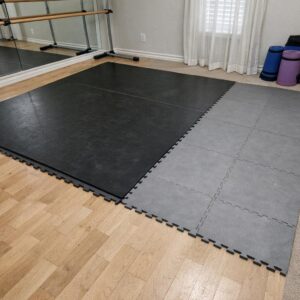
A dance surface and a sprung floor are different parts of a flooring system. Harlequin’s specifications distinguish the performance surface—such as dance vinyl or wood—from the sprung structure underneath. A roll-out surface should not be assumed to provide the same support as a complete sprung system. Source: Harlequin Floors flooring FAQs.
Even a cushioned vinyl product may be intended for use with a sprung floor. For example, Harlequin recommends its foam-backed FreeStyle surface in conjunction with a sprung dance floor. “Foam-backed” alone is not enough information to judge a home setup. Source: Harlequin FreeStyle specifications.
Before ordering flooring, give the supplier these details:
- The existing surface and, if known, what is underneath it.
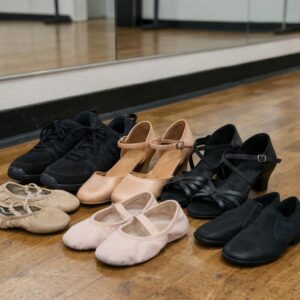
- Your dance style, intended exercises, and footwear.
- Whether the installation must be removable.
- The usable dimensions and available storage space.
Ask for written installation guidance, including approved underlayers, seam treatment, edge details, and cleaning instructions. Do not improvise a stack of household foam tiles and vinyl without confirmation that the materials work together for your intended use.
If the floor’s suitability is uncertain, ask your teacher for a reduced-movement practice plan rather than using jumps or repeated turns to test it.
Choose equipment by the task
A barre only if your practice needs one
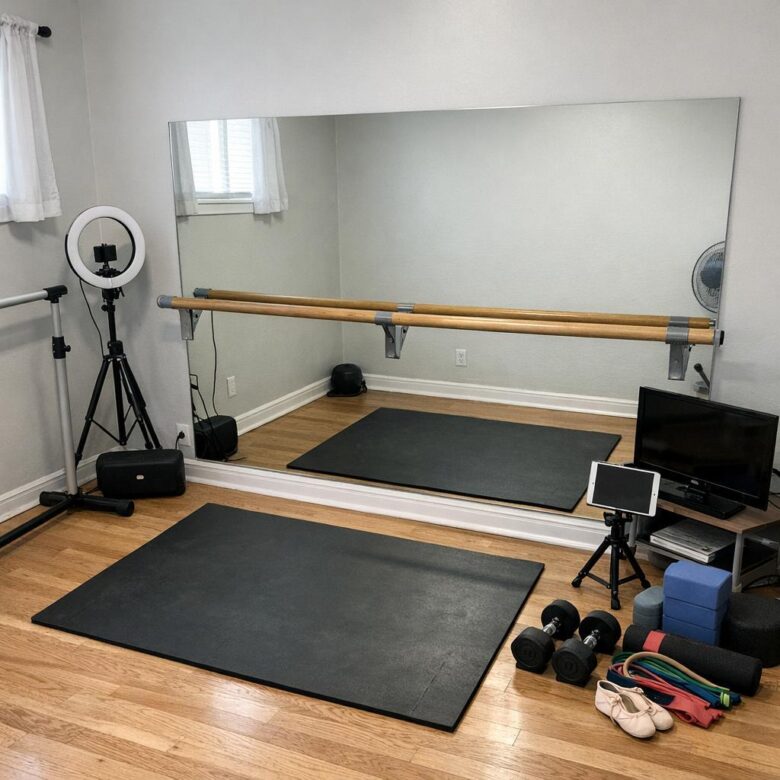
For barre-based work, compare the assembled footprint as well as the bar’s width. Mark where the base would sit and check whether you still have room to move around it. Follow the manufacturer’s assembly and use instructions; do not assume a portable barre is designed to support your full body weight.
If you intend to use a chair instead, ask your teacher whether it suits the specific exercise. Avoid treating household furniture as an automatic substitute for training equipment.
A camera or mirror—not necessarily both
Start with an existing phone if your goal is to record combinations or share clips with a teacher. Make a short test recording to check that your hands and feet remain in frame.
If you prefer a mirror, choose its location before purchasing it. Follow the mounting instructions and get appropriate installation help. Do not leave a loose mirror leaning beside the practice area. In a rental, check permission before drilling.
Audio and lighting you already own
Try your phone or laptop audio before buying a speaker. Add one only if you need more audible playback, and keep it outside the movement area. There is no need to buy a particular brand for this setup.
Test existing room lighting before adding a ring light. For video, try facing a light source and check the recording. Keep stands and charging cords out of the practice zone.
Make the room easy to reset
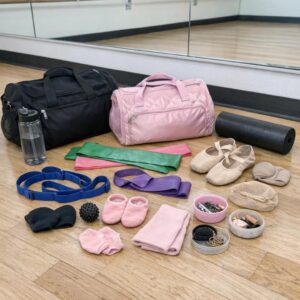
Give each item a storage location before bringing it home. Use a small bin for accessories and reserve a place for folded stands. Check storage instructions before choosing a floor roll: Harlequin specifies different storage orientations for different vinyl products. Source: Harlequin vinyl floor storage guidance.
Before each session, remove loose objects, check equipment assembly, inspect floor edges and seams, and clear the exit. In a shared building, discuss practice hours with neighbors rather than assuming a portable floor will solve noise concerns.
What to prioritize
Spend first on resolving space and flooring limitations. Then add only the equipment needed for your exercises or feedback. If a barre, mirror, or light takes away essential movement space, leave it out. A useful home setup should fit both the practice and the room’s everyday purpose.

GenDance Wellness is maintained by the GenDance Editorial Team and publishes informational content about dance fitness, beginner learning, dance gear, and safer home practice.